The Day I Stopped Believing in the Cuban Revolution
A unanimous round of applause, my grandparents' "shhh" and a teacher's warning. This is how I stopped believing in the Cuban Revolution.
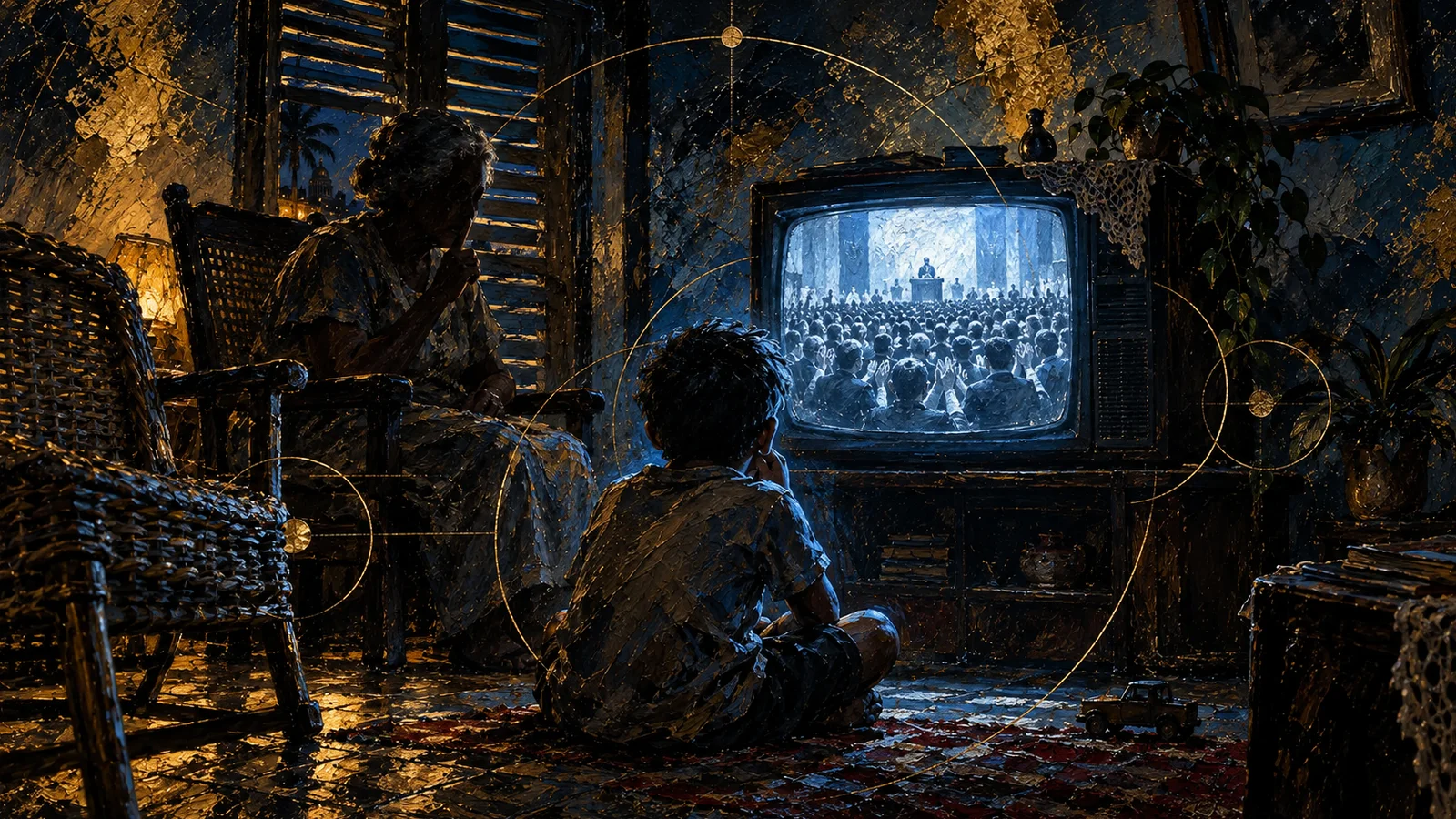
There was a day when the Cuban Revolution fell apart for me. I was at my grandparents’ house, sitting on the floor, watching one of Fidel Castro’s speeches, as we always did. And during one of them I realized that everybody was applauding. The camera started panning across the faces of all the deputies in the Assembly: they were all applauding, they stood up, and they applauded even louder.
And suddenly I remembered that in every one of Fidel’s appearances, whether on the Mesa Redonda television program or in his public speeches, there was never a dissenting voice, never an opposing view, not even a “Look, Commander in Chief, what you are saying sounds very good to me, but…”. I even felt a little afraid.
Fidel had opinions about baseball
Fidel gave his opinion about baseball in the newspaper and said he had not liked a certain play. The problem was not that he had opinions about baseball. The problem was that his opinion became a subject of analysis, the lead column. Fidel decided about the economy, about geography, about every aspect of our lives: whether we were now going to eat fish or do the ten-million-ton sugar harvest. I did not live through that, but I know it happened.
Little by little I started connecting the dots, especially when there were people at my school who spoke very quietly, very covertly, against the system, with a lot of fear. You knew those people did not agree, but you had not made up your mind yet. And in silence I made up mine.
The cult
At my school there were many portraits, but they were all of leaders of the Revolution, above all Fidel. Over time I learned that the Cuban Revolution was a cult of personality around Fidel Castro. He was its greatest achievement. He was what we were grateful for. Even when he died, the song Raúl Torres wrote for him is about exactly that: “The grateful ones go with you.”
Politics and indoctrination were present in every moment of a Cuban child’s life, from the time he was small. We had to write poetry and make works of art, and most of the time they were about the leaders of the Revolution, about speaking to Che, to Fidel or to Camilo. And as we grew up, even at the university, we were given points. We gained a much bigger advantage if we took part in more political events and if we showed ourselves to be more revolutionary.
Socialism needs those heroes
The Cuban Revolution was a very particular kind of socialism, but it is still socialism. Nobody is going to play the “that wasn’t real socialism” card on me. Yes, it was. Socialism practically needs a strong personality, it needs a certain cult, and it has always had one. We can talk about Lenin, about how they said his brain had to be preserved so it could be studied, because it was the brain of one of the greatest geniuses in human history. We can talk about the terrible Cambodia of Pol Pot, who murdered so many people. We can even talk about Che Guevara.
Socialism needs those heroes because it is a response to religion. That is why Che talked about the new man. The idea is to transform the human being toward a goal set by an elite, by a few strongmen who are seen as the Prometheuses of the people, as a kind of saviors. They give us the path to follow. And believe me, I am not exaggerating: that is how a Cuban revolutionary would talk. Fidel gave us the path to follow. The Revolution traced the road we must travel.
That way of understanding the world is violent. Extremely violent.
Approved unanimously
If you go over the laws proposed in the Assembly of People’s Power, you will see that most of them are approved unanimously, and if not, by an extremely high percentage. Every Cuban has laughed about it at some point. And it is also something terrible, because it means that things are decided by a few sacred cows.
And that, of course, makes the government very ineffective. Imagine a whole group of professionals and brilliant minds working against each other in search of the best solution. They do not agree, and in the end they have to reach an agreement through debate, argument or even compromises they make with one another. Out of that thesis and antithesis comes a synthesis, excellent or devastating. We will find out later, because it will be evaluated and criticized.
How can you compare that with two or three sacred old men deciding what two or three well-placed fat men have to say, and then suddenly hundreds of deputies raising their hands unanimously to approve it? There is no way. You will always come out losing.
What will the government give me this week?
One of the biggest problems of socialism is the monolith: the thinking monolith, the economic monolith, the political monolith. It is central planning turned into a spirit that reaches every corner of society. Socialism is a monopoly, the concentration of productive power in a political elite. They criticize monopolies, but what bigger monopoly is there than that?
It may surprise you if you are not Cuban, but we have only one telephone company. Why have two, if there is no competition anyway? They all belong to the State. We have a single electric company. Even the ice cream flavors the people can get are determined by production planned by the government. Less and less, of course, because the government has had to look for structures that test and play with the free market. Even so, Cubans still cannot own businesses where they truly control their property against the State. The State sets the rules and changes them all the time.
That monopoly turns every citizen into a slave, because it turns them into dependents. You no longer think about how to earn a living. You start thinking about what the government will do so that you can eat. And you hear it from your grandparents, your parents, your aunts and uncles: what will the government give me this week, will they bring chicken or fish on the ration book?
And it is not only the ration book. The government decides which brands will be available in the stores. It is not the market, it is not supply and demand, it is not that many Cubans want this kind of shampoo or this kind of toilet paper, so the seller imports it in order to sell it. That is not how it works. The State will decide what you eat and what you wear. And then it will blame the blockade.
It is true that there is an embargo, and that there is hostility between the government of the United States and the government of Cuba. However, Vietnam was also hostile to the American government for a long time, and it was under embargo until 1994. And today Vietnam is doing much better than Cubans are. Why? Because it opened up to a capitalist economy. Don’t get me wrong. I am not telling you that the best state is the Vietnamese one or the Chinese one. If it were up to me, I would want total freedom, because freedom allows individual mistakes that often produce genius: disruption, being for or against, debating, reaching a synthesis, not being afraid to speak. But between not having that and having at least economic freedom, the ability to produce and to eat from what you produced without middlemen and pimps from the government, I want food for Cubans and for my family.
There are brilliant inventors in Cuba. But the only ones who manage to live from it are those who get into some arrangement through which the government can export their inventions. The rest keep their inventions quiet, because in the end the government is going to take the intellectual property, or they simply keep them to themselves, in their own little world, where they enjoy them. Socialism is a monolith. It is the breaking apart of human individuality under the pretext of equality.
Speaking softly
I could not put any of that into words as a child. What I knew was that my grandparents kept telling me: “Shhh, don’t talk loud about that.” In the homes of my friends and relatives there was a kind of taboo subject, and it was criticism of the government. When we talked about those things, we had to do it in a low voice.
In every university and every workplace there was a kind of political police. They called him the Party’s ideological officer. He was the person who looked for ideological shortcomings in us Cubans in order to correct them, or to identify them and isolate them from the rest. He was the one who decided, for example, what had to be censored in radio programs because it was not ideologically correct. It was a thought police.
Anyone who has read Orwell will understand that he was a prophet. Cuba is a dystopia, and that dystopia is the life of every one of us Cubans.
The walls had ears
I remember the stories about people in the neighborhood who died at 50 or 56, and the next day they were given a military funeral. They were spies inside the people. Not their wives, not their children knew. Nobody knew. They had always been part of the system that controlled everyone else. They were part of the political police, the ones who gathered information on dissidents. And when there were no dissidents, they informed on people doing illicit business as serious and as terrible as owning a plastic machine to make electrical outlets and kitchen utensils.
Can you imagine spending so many years with your father and finding out, at 56, when he had a heart attack, that he had always been part of the political police? I understand spies in foreign countries, but a spy inside your own people? And it was not an isolated case. It was quite common, and it also happened in the rest of the socialist bloc. That is why, for us, the walls had ears.
Today we’re eating moo
We Cubans laugh at our misfortune. The sacred animal of Cuba was the cow. You could not eat it, because it belonged to the government, and killing it and eating it was a very serious crime. When someone took the risk and sold us some, we had to say it in secret. My grandmother would tell me: “Today we’re eating moo.” And she would say it like this: “Shhh."
"Careful”
Over time I realized that I was no longer part of that cult, but I could not say so in public. I could be excommunicated. And it is not simply that people stop talking to you, as happens with Jehovah’s Witnesses, or that they try to convince you, as your Protestant brothers do if at some point you stop believing in God. No. It was crueler. You could lose your job or your place at the university, because “the university is for revolutionaries.”
At the university, even at a time when I still thought some kind of socialism could be viable, I told one of my professors that the huge mural of Fidel Castro at the back of the school made no sense. Artistically it did not work. The light did not reach it in that spot. It was nonsense. In that spot there could have been a mural about Cuban culture or about the school’s purpose, or an abstract work the students could identify with.
The professor gave me a look I will never forget, with a warning: “Careful. Careful.”
She was a very kind professor. I remember her with great affection. Later she became my neighbor, and she truly was a wonderful person.
Why people keep believing
Socialism captures the minds of its captives. It turns them into aggressors, because they themselves have been attacked, as happens in a home with domestic violence. The child grows up and repeats that behavior with his own children, because he believes what happened to him was the right way to be raised, and he justifies what was done to him so that he can have had, at least in his imagination, a good childhood.
I myself, in my socialist years, was never fully aligned with the official line. But the Cuban Revolution was one of the greatest bastions of the socialist project in the region, and I felt more drawn to support it than to reject it. I understood that I was supporting it even though it was a monster with far too many flaws, one that probably needed to be taken apart and built again. I don’t remember how many arguments I had with friends. I believed the government needed some kind of control and order so that we could all build a thriving economy against the great powers that had already divided the world among themselves.
Those two things, imperialism as the hatred that lights the socialist flame and keeps you justifying every mistake your leaders make, and the fear of reprisals for thinking differently, are what keep many people still holding on to that idea.
A bird without wings
I remember how we saw tourists, foreigners. The people I live among today, my friends, my colleagues, were seen as gods capable of saving you, capable of taking you away from the fatalism of having been born where you were born. Cubans emigrated everywhere, even to Haiti, because there you could more or less do business and live. They were looking for a little air in the suffocation to which the Cuban government subjects its slaves.
To be Cuban is to be a bird without wings. It is to be someone whose wings have been torn away. It does not matter what talent you were born with. Athletes, artists, all of us born under the sign of Castroism have had to suffer the mutilation of our dreams. We have had to emigrate so that, after many years, we could begin our projects and begin to be people.
My faith in God explains it to me
I lost my faith in socialism and I am very grateful for that, because I do not believe it is compatible with a rational faith in God. Yes, there are many Christians who are socialists. And yes, of course you can be a Christian and a socialist, because you can be a Christian and so many mistaken things.
Socialism is a beautiful idea when it is voluntary. A couple of friends, a family, a married couple agree to share. The dishes belong to everyone. The house is a shared space. If you need a little of what is mine, I give it to you. I am not one of those people who want a private space and separate finances for each person. In the family there is a kind of voluntary socialism, and it is the only one that can exist, because it is bound together by love. But when socialism comes at gunpoint, it loses all its grace, because you have to smother individuality. You have to repress freedom in order to achieve a cohesion that is not natural.
Socialism is nothing more than the government of the mediocre, the dominion of the envious. Does that mean every socialist is envious or mediocre? No. There have been geniuses. But the government it establishes is a mediocre government, because human genius lies in the freedom to think, in the State not assigning the individual a fixed position, a fixed role. Human individuality is disruptive, and that is what makes it creative. That is why one of Fidel’s great outrages was to address the intellectuals, in his famous 1961 speech, and explain to them that there could be no intellectual life apart from the Revolution, which was the same as saying apart from him and his thinking: “Within the Revolution, everything. Against the Revolution, nothing.”
My faith in God explains to me that the real paradise of the human being lies in the transformation of character in a free society, a society where each person can build their own life project. If God gave us the capacity to be free, if God even gives us the freedom to deny him and to live as though he did not exist, how can my government stop me from thinking differently, from having my own judgment, my own project, my own property?
What took longer
I lost my faith in the Cuban Revolution very early, but many years had to pass before I lost my faith in socialism. I sincerely believed that cooperation was better than competition. I believed that a centralized authority directing the parts of the economy was more beneficial than having them fight each other. I believed the State had a duty to give the poorest the surplus left over by the more fortunate. But that is another story.
Patria y vida
I, thank God, am no longer a socialist. I hope my Cuba will be free, and that the dictatorship will be uprooted and removed from this land that could have been so much and still has not been, because of selfish people and traitors who, in the name of a disastrous philosophy, have created in Latin America the longest and saddest of dictatorships: the Cuban dictatorship.
Patria y vida. Homeland and life.
This is a translation of the original text in Spanish, made with the help of AI. Read the original in Spanish.