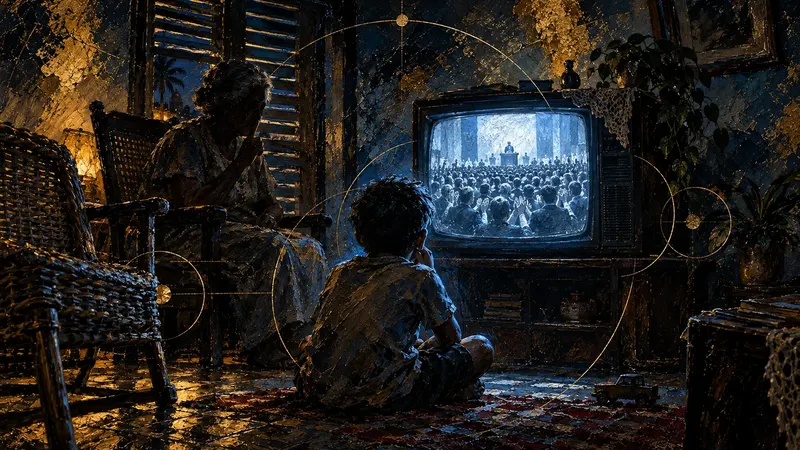
There Is Nothing Natural About Being HUMAN
If our morality is only another product of nature, humanity ended up developing a standard higher than the process that produced it. If it is not, naturalism has already lost its total explanation.
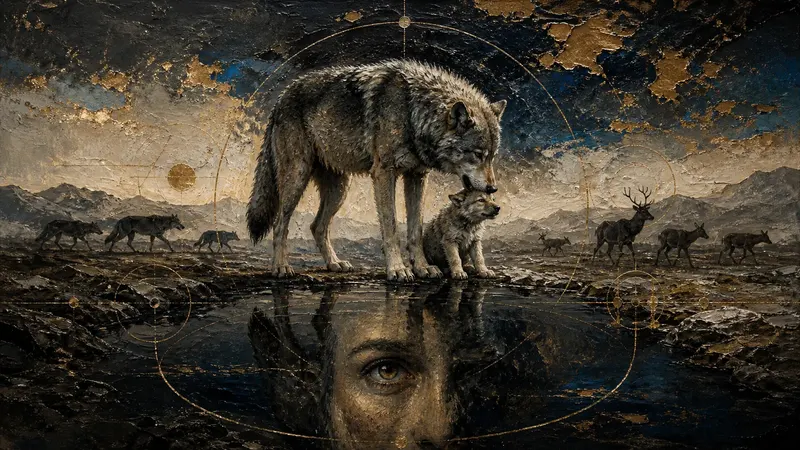
“If our morality is only another product of nature, humanity ended up developing a standard higher than the process that produced it. If it is not, naturalism has already lost its total explanation.”
Mammals display affectionate behavior. They care for their young, play, seek contact, comfort one another, and can form bonds even with members of other species. We call some of those behaviors attachment. Others, grief. Others, empathy.
So far, so good.
But the picture becomes more complicated when we talk about aggressive or indifferent behavior. How can one mammal eat another mammal alive when it also has a mouth, eyes, and teeth like its own, apparently without remorse and sometimes prolonging its suffering as if it did not matter?
We also kill and eat animals, often with an astonishing ability to ignore their suffering. Humanity does not come out of this problem innocent. But when a person tears another being apart while it is still alive, prolongs its agony, and shows no remorse, we do not simply say that this is how humans eat. We see a moral deformity, a pathology, or at the very least something that demands an explanation. Among many predators, by contrast, the same observable behavior does not appear only in a few especially cruel individuals. It is widespread, necessary, and ordinary behavior for the species.
What needs to be explained is what happens to empathy when the other body runs, screams, struggles, and clearly does not want to die, yet its suffering seems to change nothing in the behavior of the one devouring it.
The problem is not how it takes the prey down. A lion can bite the throat and a pack can attack from behind. That explains the procedure. What it does not explain is how we can speak so confidently about affection and an inner world when an animal cares for another, then immediately turn it into a collection of circuits when it tears another animal apart.
The most immediate objection distinguishes between two systems. The predator’s brain would activate a hunting circuit different from its affiliation circuit. The prey would not fall into the category of social subject, but into the category of food. The behavior would be instrumental, goal-oriented, and rewarded with dopamine. It would require neither hatred nor sadism.
But describing a mechanism does not reveal everything that exists inside a mind. Some human violence could also be described that way. Cold. Instrumental. Goal-oriented. Rewarded. And no one would accept that those four words had proved the absence of hatred, sadism, or indifference to the victim’s suffering.
A circuit explains something. It does not magically explain everything.
The Language Switch
There is a very convenient change of language in the way we talk about animals.
When an elephant stays beside a dead body, we see grief. When a dog protects another dog, we see empathy. When a mother risks her life for her young, we see love. We are not satisfied with saying that a hormonal release produced bodily movements that preserve the group. We infer an inner experience because the behavior looks enough like ours.
Yet when an orca plays with a seal before killing it, or a cat prolongs a mouse’s agony, the inner life suddenly disappears. Now there is no indifference, cruelty, or enjoyment. There is only motor training, risk reduction, overstimulation, and adaptive behavior.
How convenient. To bring animals closer to us, we interpret. To protect nature’s innocence, we reduce.
Perhaps a cat does not enjoy the mouse’s suffering. I cannot enter the cat’s mind and verify it. For precisely that reason, I should not announce as a demonstrated fact that it feels empathy because a hormone increased or because it lay beside another animal. In both cases we are observing behavior, context, and reaction. Then we infer an experience.
Have we already solved the problem of the mind? Is empathy a biological substance measured in milligrams? If so, the philosophical debate about consciousness ended without anyone telling us. If not, then let us speak more modestly about behavior and probable motives.
And if we are going to infer, let us use the same standard. We cannot enrich our vocabulary when the behavior moves us and impoverish it when the behavior horrifies us.
Someone can object that the predator does not recognize the prey as a moral subject. Its brain classifies the prey as a resource. That allows it to kill without the conflict a human being would experience.
Very well. Then we have just turned the human being into something singularly different.
Either We Are Talking About Degree or We Are Talking About Essence
Naturalism tries to avoid that consequence by claiming that our singularity is natural too. There would be no rupture. Everything would be evolutionary continuity. We have the same basic circuits, but a more developed cortex, symbolic language, and a much greater capacity for representation. Our empathy, our cruelty, and our morality would be enlarged versions of faculties found in other animals.
Then let us speak in degrees and accept the consequences.
If animal empathy is a lesser degree of human empathy, animal indifference to pain can also be a lesser degree of our indifference. If resentment, revenge, cooperation, and attachment appear gradually, there is no clean reason to stop the continuum just before the words that ruin the picture. There would also be degrees of violence, hatred, cruelty, and immorality.
The word immorality makes us uncomfortable. I understand why. An animal probably does not formulate a rule, does not deliberate as we do, and does not deserve the same responsibility. But responsibility and the moral character of an act are not the same question.
A very young child can cause harm without fully understanding it. The child’s lack of full culpability changes how we respond. It does not make the harm good or turn the victim into an abstraction. We can still identify selfish behavior in children. Some animals also have greater cognitive ability than we do at certain ages. If animals possess degrees of consciousness, empathy, intention, and ability to choose, then they will also possess degrees of responsibility. Denying that requires drawing a qualitative boundary somewhere.
And that is exactly what naturalism wanted to avoid.
The next escape is usually called emergence. We accumulated complexity until something new appeared. Water heats up and becomes steam. The brain grows more complex and moral agency appears.
The word names the leap. It does not eliminate it.
Steam does not morally judge water. The elephant’s trunk does not condemn the process that produced the elephant. Echolocation allows a bat to move within nature. Our moral consciousness does something far stranger. It looks at what happens in nature and declares that it should not happen.
If that is a difference of degree, then moral language must be extended to other animals. The excuse that declares them incapable of cruelty while presenting them as capable of empathy falls apart.
If that is a difference of essence, then one species has acquired a new kind of inner life, responsibility, and duty. The claim that materialist naturalism explained the human being exhaustively when it explained our biological continuity also falls apart.
You may choose either one. What you cannot do is call man “just another animal” to diminish him, then turn him into an absolute exception when you need to absolve the rest of nature.
Nature Produced Both
Here comes a strong objection. Morality could have evolved because cooperation favored survival. Caring for young, reciprocity, reputation, and group cohesion offered real advantages. We do not need a soul to explain why altruistic behavior appeared.
I grant that. It is a possible explanation for its appearance.
Under this theory, tribalism, deception, domination, abandonment of the weak, and our very human ability to stop seeing an inconvenient person as a person also appeared. Supposedly, evolution did not produce only the mother who protects. It also produced the fangs, the parasite, and the brain capable of turning the stranger into prey.
Which part of nature will we use to judge the other?
Saying that empathy evolved through useful or convenient mechanisms would explain, in some way, why we can feel it. It does not explain why we must obey it when lying, dominating, or abandoning someone is more advantageous. If survival produced opposing impulses, survival cannot decide by itself which one is good. Once again, we are left without an explanation for morality, the morality that says something can benefit me and yet I will not do it because, quite simply, “it is wrong.”
Someone can also object that I am mixing what happens with what ought to happen. Morality cannot be deduced from nature. The fact that an animal devours the weak does not mean we should do the same.
Exactly.
If duty cannot be deduced from nature, then nature does not ground duty. It may explain the history of the brain that formulates it, but it still does not explain its authority. Knowing why I came to believe something does not prove that it is true. The genealogy of a conviction does not replace its justification.
Another possible answer is that objective moral facts exist within a completely natural reality. Suffering would truly be bad, and reason could discover that without God.
At least that answer faces the problem. Now it must explain what makes that good objective, why it binds a creature that could benefit from ignoring it, and how a mind selected for survival acquired the authority to judge the very process that selected it as inferior. Calling a moral fact “natural” solves nothing if the word ends up including an obligation that cannot be derived from the other natural facts.
The trick is always the same. Nature is used as a total explanation until morality enters the discussion. Then a standard is introduced that can condemn nature, but everyone keeps talking as if nothing new had entered the room.
If Naturalism Wins
Let us carry the naturalist explanation to its end. Suppose there is no ontological rupture, no purpose, no higher mind, and no transcendent standard. Nature produced the human being entirely, along with the enlarged morality we now use to judge nature.
Then the natural world is profoundly immoral. I do not mean that a hurricane should go to prison or that a lion needs to repent. I mean that the entire process is filled with what our consciousness recognizes as evil: pain, terror, creatures devoured alive, the weak abandoned, diseases that consume bodies, and species whose survival depends on the suffering of others.
We can remove the word immoral to make ourselves more comfortable. The suffering will still be there. So will our judgment of it.
If that judgment is only an evolved preference, there is no ultimate reason for the powerful to obey it when they can live better as predators. We can invent laws, agreements, and punishments. We can say that we do not want a society like that. I do not want one either. But a collective preference does not turn compassion into truth. Once punishment, reputation, and reciprocity disappear, the question remains. Why not behave like the very nature that produced us?
That road ends in nihilism, even if we build a beautiful city before we arrive. Morality would be a useful tool, perhaps a necessary one, but not a real obligation. Force, domination, and predation would remain as natural as care.
The other way out is to declare that our morality really is superior to the natural process. Thomas Henry Huxley, a biologist and one of Darwin’s great defenders, at least had the honesty to accept it. In Evolution and Ethics, he argued that ethical progress does not consist in imitating the cosmic process, but in fighting it. Civilization restrains natural struggle, protects the weak, and demands self-control where selection favors self-assertion.
That saves morality, but it leaves a rather strange creature on the earth.
Nature produced an animal that rose against it. An animal that looks at the means by which it came to exist and declares them inferior. An animal that no longer accepts survival as a sufficient good, that protects lives offering it no advantage, and that can surrender its own life for someone who does not even belong to its group.
In the end, the naturalism that wanted to knock us off the pedestal almost deifies humanity. We would be the point where nature transcends itself, becomes conscious, discovers that it had always acted wrongly, and begins to correct itself.
I see no humility in that conclusion. I see the human being occupying the highest place available in a universe without God. We are the product of the process, the judge of the process, and the process’s only hope of redemption.
Either that, or nihilism. Either our morality is not true, or it is superior to the nature that produced it.
The fork is already on the table.
If the difference between us and other animals is only one of degree, then nature carries real degrees of empathy and also of cruelty, indifference, and immorality. The natural world is no longer innocent.
If the difference is one of essence, if a moral consciousness appeared in us that can understand duty and judge even its own impulses, then strict materialism is not enough. Belief in a higher agency, natural or divine, is more than justified. There is already a serious reason to think that the human mind cannot be exhausted by the same terms we use to explain hunting, hunger, and reproduction.
And if naturalism insists that it produced that difference by itself, it must accept the price. It accidentally created a being morally superior to nature, almost divine, charged with fighting its own origin or resigning itself to all morality being a useful fiction.
I am a Christian. That is why I do not need to declare nature good simply because it is nature. Paul can speak of a creation that groans, subjected to corruption and waiting to be set free. He can call death an enemy even though death is buried deep in our biology. He can say that we come from dust without reducing us to dust.
He also says that the human being was made in the image of God. That means our singularity is neither an inexplicable accident nor a crown we placed on our own heads. The conscience that accuses, the love that sacrifices itself, and the refusal to turn the other into food or a tool come from a standard higher than hunger and survival.
Nature can explain why I have teeth. It cannot compel me to decide that I must not use them against the weak.
For that, something above nature is needed. I call it God.