Maceo Against Vulgarity Disguised as Cuban Identity
The anti-asere Cuban
Against Vulgarity Disguised as Cuban Identity
There is an image of Cubans that bothers me because it is not entirely false.
If it were a caricature invented by our enemies, rejecting it would be enough. But we have seen it too many times in the average Cuban, or perhaps in the Cuban who stands out most precisely because of these traits: noise, indiscipline, the tough-guy pose, and an almost childish confidence in vulgarity. I mean the kind of man who needs to hear two pingas and three cojones before he is convinced that someone spoke plainly. The one who confuses character with swagger. The one who only recognizes strength when it arrives shouting, insulting people, or turning brazenness into proof of manhood.
The Cuban people are something else, or at least they once were. And I do not mean those who put on aristocratic airs. Among the humblest people, even those who never learned to read, there is nobility, grace, verbal intelligence, sacrifice, and endurance. The falsification begins when we use the word people to excuse any kind of baseness. We label every vulgar outburst authentic. We call lack of manners humility. The street ends up excusing the man who cannot govern himself. The moment someone asks for honor, thought, or the slightest elevation in speech, he is accused of being too refined, soft, pampered, arrogant, out of touch with ordinary people, or simply not “real.”
I will use “asere” here for that kind of morality and that kind of Cuban, not for the word in its friendly sense.
Used cleanly, asere can be a noble word of closeness in Cuba. It can mean a friend, a partner, one Cuban recognizing another without ceremony. But here I will use it in its degraded form: a way of being that soils whatever is great in order to make it feel familiar, and can no longer distinguish the popular from the vulgar.
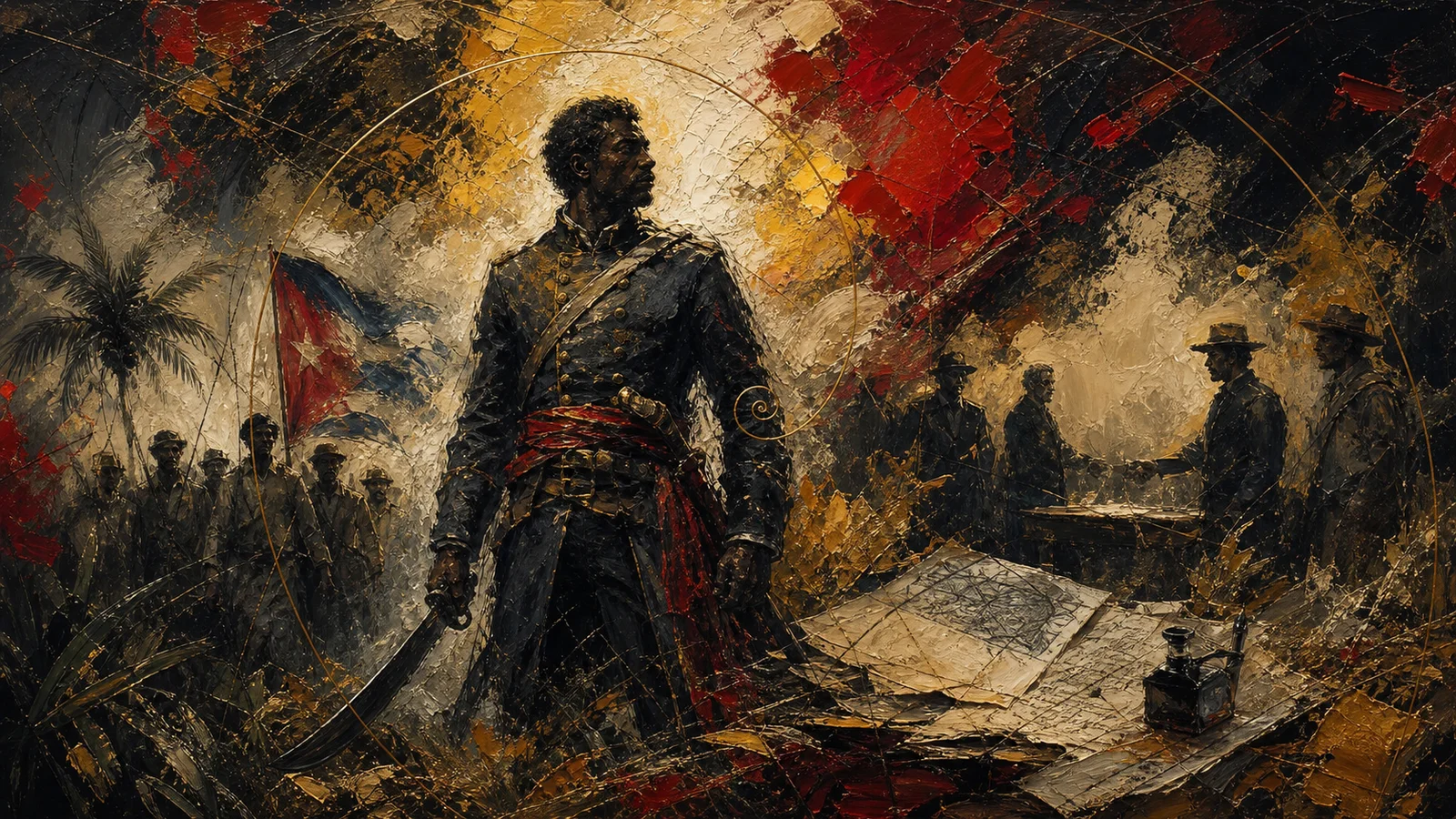
This is where Antonio Maceo appears, as a contrast to this asere and as a model for a new Cuban man who is much “older” than we might imagine.
One of the strongest men in our history did not need to become brutish in order to lead. Maceo was a particularly interesting Cuban. He was mixed-race in an age of racism, self-taught because he could not access the same education as his Creole peers, strong and courageous, but intellectually awake and, above all, honorable. I am not talking about an idol viewed from a distance. Time does polish statues out of men of flesh and blood who were anything but perfect. I am talking about the image Maceo aspired to embody. An image very far from the asere. Very far from the loud, genitals-obsessed neighborhood man that many Cubans aspire to be today.
Maceo does not appear here to look down on the people. He was a mixed-race man of farms, camps, war, wounds, persecution, and command. That is precisely why he matters. His life dismantles a comfortable excuse: the idea that a hard existence authorizes crudeness. If he preserved his dignity in the manigua, nobody can claim dignity belongs only to those who live comfortably. If his street was an actual war, nobody has the right to call verbal elevation a “lack of street.”
Martí saw him with a precision that still corrects us. He said that Maceo had as much strength in his mind as in his arm. The sentence shatters the caricature. He was not just machete, body, bronze, or the myth of the fierce mulatto. There was an inner architecture in him. The physical strength was there, but it did not stand alone. There was also judgment, self-command, and an understanding of what a republic demanded.
That combination is difficult to imagine today because we have grown accustomed to separating strength from refinement as if they were enemies. On one side we place the educated man, supposedly useless in a fight. On the other we put the vulgar tough guy, presented as authentic because he dares to do what others will not. That division is false, and worse still, it belongs to damaged peoples. The Titan fits neither mold. He was neither delicate nor crude.
The Protest of Baraguá concentrates that difference almost unbearably. In 1878, after a long and exhausting war, the Pact of Zanjón offered a way out. Not victory. A way out. We have to take that temptation seriously because Maceo, too, suffered the ravages of war, and his mind and body were asking for rest. Exhaustion makes arguments. Destroyed families, the dead, disease, exile, and poverty weigh on anyone’s conscience. Even so, the Bronze Titan rejected the way out at the exact moment when accepting it could have seemed humanly understandable. The sentence that remained in Cuban history defines the kind of anti-asere man before us:
No nos entendemos. We do not understand each other.
There were no obscenities, no shouting, no blasphemies. Not because these things did not exist in that age, since they have existed in every age, but because they have no place in dealings between two men of honor, great men even as enemies. Men capable of cutting off each other’s heads, yet able to treat one another with respect in the middle of negotiations. The asere cannot look at his enemy without hurling a couple of pingas at him and feeling triumphant for such a feat.
Cuban communism must be accused of forming, or deforming, this person inside every one of us. Because yes, every one of us carries a little, or quite a lot, of that asere within. Caribbean communism did not merely impoverish, repress, and expel people. It also vulgarized them. It trained human beings to live without public truth. After decades of that, the word of honor breaks apart. A person says one thing, thinks another, and does a third.
Blaming communism alone, however, would be too comfortable. Castroism aggravated and systematized the damage, but it did not invent all our defects. If the dictatorship falls tomorrow and the degraded Cuban remains intact, we will have new symbols laid over a broken soul. A soul that accepted the banana-island stereotype and allowed itself to be remade for tourists, servile to the visitor in order to earn the daily living the government cannot provide. We let ourselves be seduced by the drug of reggaeton and the gold chains of gangster culture, or what in Cuba is called reparterismo.
Maceo’s figure forces us to ask what kind of Cuban can build and sustain a post-Castro Cuba. Hating the tyrant is not enough. We must form human beings who will not need another tyrant afterward. Shouting freedom is not enough either. We have to become capable of using freedom without debasing ourselves, without constant vulgarity, and with a highly developed mind. Being on the right side of history does not guarantee moral health.
That point is irritating, but it needs to be said. There is a vulgar, resentful, opportunistic, and hollow anticommunism. There is an opposition that identifies the right enemy but mistakes the kind of human being Cuba needs. Someone can be right to hate the dictatorship and still be incapable of living as a citizen. And Florida is already suffering this reality, according to criticisms from older members of the Cuban diaspora. A generation has arrived that shouts “Free Cuba” with a mouth accustomed to obeying no idea of honor.
That is why I want a name for the man we need, the Cuban woman who builds society, the citizen who knows how to live with others in honor and respect: the anti-asere Cuban. He does not despise the neighborhood, but he demonstrates that the neighborhood does not have to become the moral measure of the homeland. He does not need to dress up as a tough guy in order to be brave.
And that was Maceo too, a deeply Cuban Maceo who comes to demand that we rise to his height.
Nobody wants Martí or Maceo to remain dead in an elementary-school mural or a state political ceremony. The problem begins when we do not know how to bring them back to life without turning them into little street-tough durakita caricatures of our own degradation.
That is what people have tried to do with Antonio Maceo. Cuban expressions such as más cojones que Maceo (“more balls than Maceo”) or la pinga de Maceo (“Maceo’s dick”) exist because Cuban popular speech translated his courage into the language of cultural degradation. That vulgarization says more about us than about him. A broken people’s soul often admires greatness, but because it cannot sustain greatness at its proper height, it shrinks it to its own size.
None of this means Cuban humor is the enemy. Without humor, we probably would not have survived. It can defend the weak from the powerful, deflate the tyrant, ridicule false solemnity, and keep fear from becoming absolute. But there must also be a place for the sacred, the dignified, and the honorable. Our choteo cannot be eternal and unrelenting. We are not goblins.
There is a kind of choteo that liberates and another that keeps the mediocre at ease. The first mocks power. The second mocks anyone who tries not to resemble his surroundings.
This also appears in political debate, especially when Cuba is the subject. Someone tries to think morally about opposition to Castroism, and the comfortable answer immediately comes back: arguments are unnecessary, anything against the dictatorship is useful, the important thing is to “tell it like it is.” But if everything is useful, nothing builds. A homeland cannot be raised on antipathy toward the enemy alone. It needs an idea of the human being.
We are not a people without an inheritance.
Our inheritance has been interrupted too many times. And an interrupted inheritance leaves broken pieces that are later confused with identity. That is where so many lies come from: Cubans are unfit for law, they need a strong leader, they only understand force, they cannot speak without shouting, vulgarity is in their blood.
Against that lie, Maceo’s life is uncomfortable evidence.
It proves that another way of being Cuban existed. A way of being Cuban with flesh, a mixed heritage, pain, and history earned in the streets, but also with honor. Once a possibility has existed, it is no longer a fantasy. It may be buried, weakened, interrupted, but it has not been abolished.
The anti-asere Cuban is still one of the people. He can speak from below, with anger, with force, with harsh words when they are needed. The difference lies at the moral center. He does not use the people as an excuse to debase himself. He does not fear conflict. Nor does he confuse conflict with chusmería, with vulgarity as a way of life. He knows a nation cannot be saved if its people learn only how to survive.
We must recover the capacity to feel shame before certain ways of living. Not shame at being Cuban. Shame at calling everything that diminishes us an expression of Cuban identity.
From that uncomfortable height, Maceo is still watching. He does not ask us to stop being Cuban. He asks us to stop using our Cuban identity as permission to become worse. He reminds us that strength can have form, that popular origins do not require chusmería, that a wound has no right to govern the soul, and that a peace without dignity does not deserve to be bought under the name of peace.
In the end, Baraguá remains the necessary answer. Not as a schoolroom slogan, but as a stance against everything that wants to diminish us and then convince us that this is realism.
No nos entendemos. We do not understand each other.
That answer applies to the dictatorship that destroyed the homeland while speaking in its name. It applies as well to the part of the exile convinced that hating communism is enough to be morally sound. It stands against vulgarity sold as authenticity, against the choteo that drags down everything great, and against the miserable notion that being of the people means living without manners or self-command.
Maceo, the anti-asere Cuban, does not come to take away what makes us Cuban.
He comes to return it to us, cleansed of one lie: that our degradation is our essence.