Is Cuba a dictatorship? Two articles of its own law prove it
It is not something people say out of passion. Where there is no change and no possibility of change, there is a dictatorship, even if it holds elections.
Can we say, in practical terms, that Cuba is a dictatorship? Or is it something people say out of passion, because they don’t like the government?
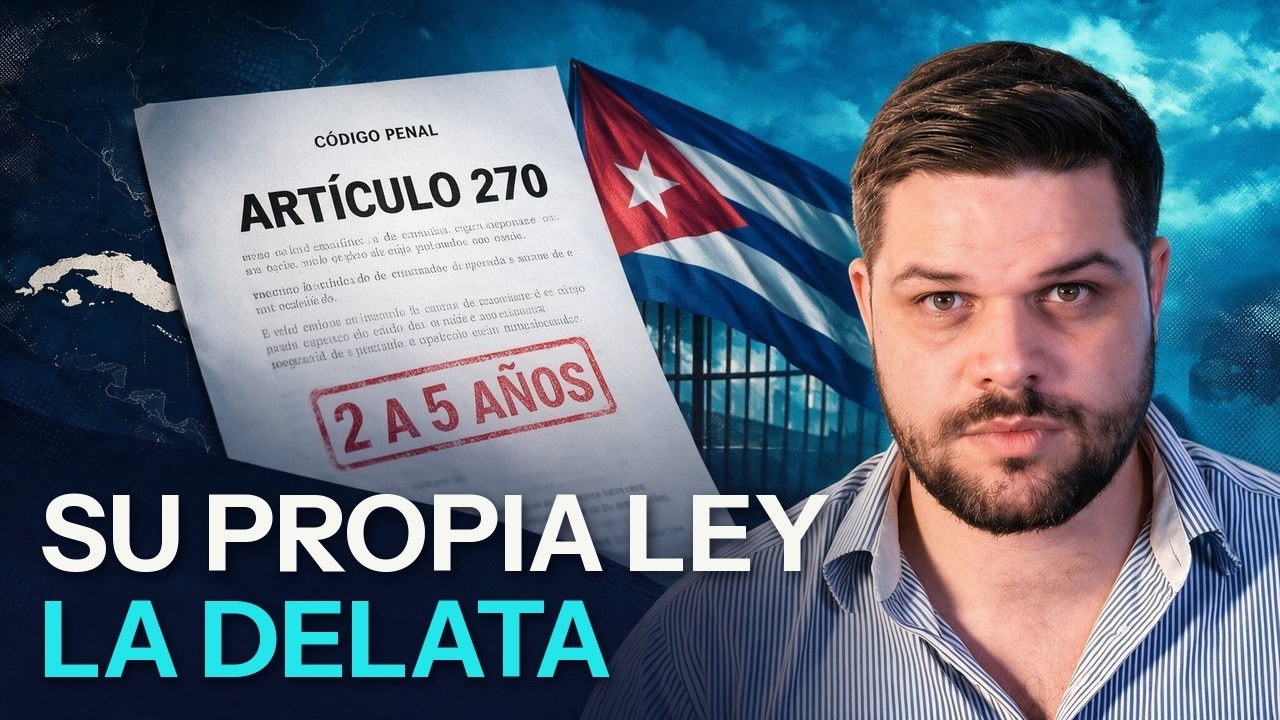
Cuba has two articles that give it away. Or rather, not Cuba, the Cuban government: two articles of its Penal Code that expose it as a dictatorial, authoritarian government, one that can be understood as a dictatorship.
The first is Article 270, which says you cannot disparage the institutions, the heroes or the martyrs. And those institutions include, of course, the National Assembly of People’s Power and the presidency. The second is Article 124, which punishes propaganda against the socialist state. They do not stay on paper. On the basis of those two articles, among other charges, the prosecution is asking for 8 and 10 years in prison for Ernesto Ricardo Medina and Kamil Zayas Pérez, the two young men from El4tico who made videos in Holguín.
This happens in many dictatorships around the world. In Africa, for example, many put that same kind of safeguard into their penal codes: you could not speak against the authorities. But imagine what happens in Cuba. You have a one-party country that defends a system, and you cannot attack the system. The 2019 Constitution itself says that the Communist Party is the “only” one, that socialism is “irrevocable” and that this can “in no case” be amended. Where does that end? With the people running that party staying in power forever.
That is why what we Cubans have to do is stop taking part in the regime’s attempts to clean up its image before the world, to make the world believe that Cubans have some kind of say in how they are governed. To understand why, we first need to know what a dictatorship is.
The three powers in one pocket
A dictatorship is nothing more than the concentration of all powers. The problem is that people don’t know what those powers are.
The first is the power to repress, the power to do physical harm, which is the Executive Branch: the police, the military, everything related to repression. That power has to exist in any country. In Cuba it is held by the little racket that governs, the red party. How do we know? Because the soldiers, the police officers, the general at the ministry and everyone below them have to belong to the red party. Those people are members by obligation and have to follow the orders that come from the party. There you already have one power.
Then there is the Judicial Branch, the one that decides who is guilty and who is innocent according to the laws. If the Supreme Court judge, the prosecutor and the rest have to be bound to the party in order to hold their posts, you also have the Judicial Branch in your pocket. In Cuba the Assembly elects the Supreme Court and the Attorney General, and the Constitution leaves the Attorney General’s Office “subordinate to the President of the Republic”.
And there is the Legislative Branch, the one that makes the laws, like the law behind that article saying you cannot go against the socialist state. If you also have the lawmakers tucked into your party’s pocket, you hold all three powers. And you are clearly a dictatorship, because you concentrate all the power.
The impossibility of change
Let me make it even simpler. What defines a dictatorship? The impossibility of change. When you have a system that cannot be changed, that is a dictatorship.
Someone might argue that democracies can’t be changed either. Careful. In the United States there are Alexandria Ocasio-Cortez and Bernie Sanders, who call themselves socialists, sit in Congress and are a danger to those who don’t share those ideas. In fact Trump, who is on the right and wants to fight those ideas, says they are a danger. There you can change things. There are monarchical democracies that stopped being monarchies, like Barbados in 2021, and there are peoples who chose to remain monarchies, like Australia in 1999. There is a fight that can be fought through legal means so that the majority of the people end up deciding the destiny they want for themselves. Sometimes the left governs, sometimes the right, and sometimes people like Gabriel Boric, who governed Chile in alliance with the Communist Party and then handed power to José Antonio Kast, from the right.
That is a democracy: a place where you see change and where those who govern are afraid of losing power if the people think differently, so they try to win the people over by every means. Is it perfect? No. But it is much better than not being able to decide, and than having those who govern end up as a modern feudalism, with no peaceful way to remove them from power.
So, is Cuba a dictatorship? Obviously. Clearly. And the Cubans in the political elite who know a little about Marxism-Leninism, which Cuba declares as its unchangeable system, won’t deny it: they will tell you it is the dictatorship of the proletariat, because that is how it is defined. For Marxists who remember how socialism works, that is a good thing: establishing the power of one class with the goal, they say, of eventually abolishing classes. The proletariat are the workers, those who have no capital. And are there capitalists, bourgeois, in Cuba? No. But that is the story: a dictatorship of the workers over the bourgeois, in which the workers give power to the government so that the bourgeois won’t have it, and the government gives power back to them according to what the workers say and want.
The most loyal opposition
What if a dictatorship has several parties? Several parties can exist in a dictatorship, as long as their ideals are in sync. To understand the difference between a dictatorship and a democracy, look at England. There the leader of the opposition, or the opposition in general, is called “His Majesty’s Most Loyal Opposition”. The opposition wants to bring down the governing party, is completely against its ideology and wants to do things differently. And yet it is understood that its existence is so important for democracy and for the power of the British people that the governing party is expected to refer to those who want to remove it as “most loyal”. It is not loyal to the governing party, it is loyal to the people. That is why it cannot be branded disloyal just for wanting to remove them from power.
That is the difference. A dictatorship can have several parties, but parties it authorizes, because whoever is in power decides whether a party is authorized or not. There is democracy when a law says: if you meet certain requirements, which I as the government do not control, you can form a party, run in elections, try to bring me down and remove me from power. When there is a legal and peaceful way to completely change the course of the government and the people in power. When we are not continuity, but change, the exact opposite of what Díaz-Canel’s campaign said when he took over from Raúl Castro: “We are continuity”. Where there is no change and no possibility of change, there is a dictatorship.
It is all a simulation
Why does a dictatorship hold elections? It is one of the strategies the communist regime has used to clean up its image before the world. It has done it many times, because there is pressure, and also because people want to take part. The problem is not how many people go to vote. The problem is whether they had a different option or not.
The regime’s goal is to create an illusion of democratic participation, so it can say: in Cuba people vote, in Cuba people take part in the government and are happy with it, and you have no business meddling in what we have sovereignly decided.
Let me explain. Years ago there was a “vote for all” campaign, and it was very comical. Important government positions were being filled, and the government wanted the people to take part in a simulation of democratic voting, so the whole world would see that it did give them a say in how they are governed. The ballot said: “Vote for all”. That option existed because the government had already decided who was going to take power. They place them by loyalty, by who licks whose boots the most, by whatever they see fit. They are all handpicked. And many Cubans went and marked the vote for all: what other option do I have? This won’t change anything, but I’ll go and take part. And the government could say: here are my votes and my democracy.
There is no democracy of any kind when there are no different options. When everything is the same, there is no democracy. And what we should have done as Cubans, and what must be done from now on, is not take part in any of those image cleanups.
I understand you. People think it is better to take part than to do nothing. That maybe they are supporting a small change inside the regime: today it is “vote for all”, but tomorrow it will be for So-and-so or Such-and-such, and maybe So-and-so has a different program from Such-and-such. Maybe within socialism and within the one party, but it would already be some kind of freedom, some breathing room. I know you think all that, and that is why you go and vote. Other times you go so you won’t be marked, which is what happens most of the time. And other times out of inertia: that day we’re bored, there’s a blackout, so we go vote.
No. You are hurting yourself and you are hurting Cuba. You should only take part when there are truly free elections, when anyone, not just the people they designate, can put forward a different proposal through legal mechanisms that have nothing to do with an ideology, a party or their authorization, and the people can decide. Then, yes, you have to vote. But when everything is handpicked by them, voting gives the world an idea of Cuba that is different from what it really is. And that is exactly what they want. It is all a simulation meant to present themselves as democratic to the world, and we cannot give them that satisfaction.
Who is going to feed my family?
What happens if you don’t go to vote? Right now, if a whole block stops voting, nothing. If it’s two or three people, those people will be marked: these ones aren’t revolutionaries. But that is what we need. We need to start saying what we really are and what we really think.
Someone could tell me, with good reason: look, I have a family. If I don’t go, if I don’t sign, if they mark me, who is going to feed my family? You?
I understand you perfectly. And it’s true, I’m not going to feed them. But the Cuban government won’t either. Your grandchildren are probably going hungry, and your grandchildren’s children are going to live in an even more disastrous Cuba, because they are taking everything from us and we don’t matter to them at all, because in the end we don’t even do the bare minimum.
It is hard to ask anyone for sacrifice, but some sacrifice has to be made. I’m not telling you to take to the streets right now, because it won’t be worth it: we don’t have the unity we need in the opposition to achieve a favorable result. At some point, yes, but not now. But we have to start using strategies that have worked to bring down other dictatorships, and one of them is to resist: to let everyone know what you really think. To stop living in hypocrisy. Cubans have lived in the lie for far too long. We were taught to lie to get positions of power or to avoid punishment. We need to start saying what everyone thinks: that this is a dictatorship, that we need freedom, that we want a twenty-first-century Cuba, that we want democracy. And one of the ways to live in truth is to stop signing.
What about my children? You have to find a way to live away from the state. What do your children do? Engineers, drivers, doctors? I don’t know, but you have to find a way. And if they take your children’s jobs away, expose it on social media. Let’s make sure the opposition can truly support, including with money, the people in Cuba who take that step of telling the truth.
I’m not saying it will be fast. Unity is hard, but we are looking for a unity in the opposition that lets you say: I did it, here is the proof, now I’m suffering the consequences. And that all of us together can help you, you and your grandchildren. That also asks a sacrifice of us. It is the minimum we owe and can do right now.
Are there consequences? Many times, yes, but most of the time, no. They can’t jail a whole block for not signing, because it looks even worse and because they depend on their international relations.
Do you realize how much power you hold in your hands?
And those international relations have to do with where the Cuban government gets its money. It gets it from two sources. First, from controlling the country however it damn well pleases: mining nickel and other important minerals, controlling maritime trade and tourism, exporting doctors, and making sure the private sector has practically no control over what matters and what makes money. The doctors abroad alone bring the regime between 6 and 8 billion dollars a year, and the state keeps 85% of what they earn.
Second, it all has to be sold to someone: to Russia, to Iran, to Spain, and I’m putting them in that order on purpose. The more democratic the country it sells to, and the more that country’s government depends on its citizens to stay in power, the more Cuba needs a pretty face before the world, and the more justified trading with Cuba has to look. If the Cuban government loses that pretty face, Spain will no longer want to deal with it, because then it won’t be able to trade with the United States, with England, with Germany or with other democratic countries. That is how it works.
That is why it is so important that we no longer allow the Cuban government that lying democratic little face, which holds up because we tell lies too. Do you realize how important it is that you don’t sign? Do you realize how much power you hold in your hands?
The economy is built on trust
And a democratic Cuba serves everyone. Let me explain why. The economy is built on trust. Let me make it simpler: you don’t do business with someone you distrust. Among Cubans, when we’re doing a deal, people say: relax, a Cuban can be trusted, I’m a man of my word. Trust is the foundation of all business.
Dictatorships don’t create trust, because they depend on the unlimited power of a group of people, and when that group changes the rules, the entrepreneur is screwed. In Cuba they govern all the time by decree-law. Now we ban the dollar, tomorrow we allow it, the day after we open exports. Oh no, now exports aren’t for nationals, now they have to go through an agency I choose. And that agency is corrupt, so you know you have to pay extra.
A government that depends so much on the king, or the kings, on the figures of power at the top, is an unstable government, and investors don’t want to put their money there, because they’ll lose it. A government that expropriated multimillion-dollar companies and never paid compensation, or paid it however it felt like, scares off any investor. Americans alone have 5,913 certified claims for property expropriated from them in 1959 and 1960, and Cuba never paid them. That is why dictatorships tend to be so prone to bankruptcy: it is very hard for one person, or a group with absolute power, to be trustworthy in a negotiation. They can turn on you at any moment.
A democracy is more trustworthy because it doesn’t depend on a fickle human being, or on the power of a handful of individuals. It depends on laws that are there, set on firm pillars, that don’t change because they are constitutional, and that hardly interfere with people’s economic lives. A dictatorship, on the other hand, is a group of people trying to seize all of a country’s wealth for their own benefit. That is why they make laws, create enemies and create historical stories so the people will endure.
Why am I telling you all this? Because a democracy makes Cuba more prosperous, and your grandchildren, your children and my children could live in a much more prosperous Cuba if it were democratic. When you resist, when you live in truth, with that minimal resistance Václav Havel spoke of, the last president of Czechoslovakia and the first of the free Czech Republic, you are building an economy without knowing it.
In a democratic Cuba we will be able to say: we have this water reservoir next to this plain that is going to waste today, and we’re looking for an investor to set up a business there so the surrounding towns can improve their economy. And the first thing that investor will ask is whether any contract with you, any law, meets democratic standards he can trust, or whether tomorrow a government will come and take everything from him because it decided it isn’t fair and his money belongs to them. The more stable and democratic the country is over the years, the less it depends on one person and the more on its laws, the more investors we attract and the more money we all have. And the Cuban minimum wage, which today is less than 4 dollars a month, starts to grow toward, I don’t know, five hundred or a thousand dollars. And we start being normal citizens of the twenty-first century.
”We are not going to pay the debt”
Fidel Castro became famous for that. In 1985, in Havana, at a conference on foreign debt, he said, very funny of him, that they were not going to pay the debt, and he started looking for synonyms. Comply, we don’t want to. Repeal, yes we want to. Annul, yes we want to. Abolish, yes we want to. And if you don’t like any of those, he said, there is another very clear and intelligible phrase: not pay. Everyone laughed along with him. But an investor sees that attitude and says: wow, you’re shameless, a scoundrel, I’m not investing in your country. Cuba stopped paying its debt the following year, and again from 2019.
Fidel became so famous for it that in an episode of The Simpsons, one of the most important series in pop culture, Fidel Castro appears with a capitalist, one of those through whom the show mocks the love of money. Look at how it goes. The capitalist shows him a bill. Fidel says: let me see it. The capitalist asks whether he’ll give it back. Yes, yes, let me see it. Fidel looks at it, puts it in his pocket, and when the capitalist asks for his bill, he answers: what bill? Look at the reputation Fidel built, and the lack of trust any investor could have in Cuba and in its government.
The rotten potato
That doesn’t mean the dictatorship, with its inability to attract foreign investment, is the only thing hurting the Cuban economy. It is true that the embargo, on one hand, limits investors who might take the risk. It didn’t limit China, or Iran, or Spain, which came to have a pile of hotels there. But it did limit others. That’s true.
But it is also true that inside the country the farmer, the grower, has to sell everything to the state. And what reaches Cubans is whatever couldn’t be exported. It’s misery: the rotten potato, the tiny one, the lime that barely tastes of anything. What won’t be eaten abroad is what reaches the Cuban people. And everything that comes in is kept in tax havens by the Castros, the Castros’ children and the generals’ children, who even justify themselves: my dad keeps that money there because it’s needed for anything, to inject it or to buy weapons, in case they invade us.
In the end the people are left without food, and that has nothing to do with foreign investment. It has to do with Cubans not being allowed to do whatever they want with their money and their property.
That is the beauty of capitalism
Private ownership of the means of production is the ability to say: this is mine, I’m going to expand it, I’m going to make it grow, I’m going to hire people to work it, and if I make the right decisions and work very hard, there will come a time when what I have multiplies and I have a lot of money. That goes against socialism. But it is also what makes a prosperous domestic market.
Because whoever says “this is mine and I’m going to make it bigger” is going to hire people. These people don’t work out because they don’t work well, I’ll hire others. They don’t work out either. Hmm, maybe I’m not paying enough. I’m telling you because I’ve lived it: I’m close to my boss and to the place where I work, and I hear those conversations all the time. We have to pay more, because otherwise the staff we’re recruiting isn’t what we can offer the client. Nobody wants to pay workers more. But you end up paying it, because if you don’t give good service, clients stop hiring you.
And look at what just happened: you just created jobs, and you didn’t have to be a good person to do it. That is the beauty of the market, the beauty of capitalism: you become a public servant, because you can’t take people’s money by force. What’s left for you? Convincing them.
You’ll tell me that people get fooled a lot in the market. But you can’t take away people’s need to decide for themselves, to make mistakes or to make good decisions. The Cuban regime does not allow that. And every time it allows it, it’s with tweezers.
A fine line
Why do you think they’re opening up the economy now, allowing things they didn’t allow before, like private banks or other businesses? It’s not because they believe in it or because it does them good. All their lives they’ve been afraid of Cubans gaining economic power, because they know the economy gives you power to make political decisions later.
They’re doing it because they have to clean up their image before the world, and probably because they’re seeking some kind of negotiation with the United States. They’re telling it: look, here we’re starting to put in place semi-democratic legal mechanisms, let’s do this the best way, without me losing power and so you can do business here. They’re sort of inviting it, putting on perfume, dressing up nicely, swaying their hips so the United States will look at them and say: well, maybe I won’t cut your head off, maybe I’ll negotiate with you instead, because I’d rather negotiate with a dictatorship I can control than with a democracy where I don’t know who I’ll end up having to reason with. Look at where this is heading.
They themselves know what they need and the delicate balance they have to keep as dictators, between being trustworthy for the world and keeping a rigid grip on their own people. We too, the opposition, those of us seeking a new Cuba, have to play on that fine line, to keep them constantly in check. Every time they open up the economy a little, we have to show the world all the other dictatorial laws, the political prisoners, everything that’s going on. We have to not sign and not take part, to counter that image cleanup. And every time they tighten their dictatorial grip somewhere else, the opposition has to give Cubans on the island opportunities through the internet: offer them work and ways to earn money without depending on the regime’s systems. We haven’t achieved that yet. But that way, more and more, we’ll keep cornering them.
Me too, me too, me too
What if everyone at your job goes to the May Day march? What can the fear be? That you’ll be the only one, the lone beachhead, the one stick that doesn’t make a bundle, as we say back home. That you’ll get marked and say: wow, I did this, and in the end everyone went to the march, everyone took part, and I didn’t. That is a risk, and it can happen in many places.
But I’m calling on the brave first to do something I did too. I went to the 15N march, the Civic March for Change of 2021, when we were called. I got marked, I made it public, I didn’t hide. And why am I calling on them first? Because I know a chain reaction comes afterward.
A lot of people say that’s already happening in Cuba, that people have already stopped believing. No, my brother. People have stopped believing, but when the moment of truth comes, they show up out of fear. That’s why you see marches, signatures, all of that. You and I, the ones who didn’t do it, are a minority. The majority doesn’t believe in the dictatorship, is tired of it and craps on the revolution every chance it gets, in private, with its own people. But when an official event comes, they take part.
Why do I tell you there will be a positive chain reaction, and that a moment will come when you won’t be the only one? Because it already happened. I’m not talking about a forecast, about something that might happen. I’m relying on the past. In Poland, in Hungary and in Czechoslovakia people began making these decisions, and others began to say: I’m one of those people too. Me too, me too. They kept joining, and there came a point when there were more people joining than not. And then they had power. In Czechoslovakia, on November 27, 1989, 75% of the country joined the general strike.
The opposition needs the support of Cubans and needs their truth: for Cubans to tell the truth. And we, of course, need to unite to support them, to support those inside. It has to come from both sides, or we won’t succeed. The Poles took the risk, the Czechs took the risk, and there wasn’t a bloodbath, at least not in those cases, because it was done intelligently. In Tiananmen there was one, because it wasn’t done intelligently: the regime got scared when millions of students and other people took to the streets to protest, the opposition wasn’t ready for that yet, and they were completely crushed. That’s not what I’m telling you. I’m telling you to do what was done in those other places of the socialist bloc, and what worked in the end. It has been done before. Why can’t we do the same?
The video, in Spanish, on YouTube: ¿Cuba es una DICTADURA? Dos artículos de su ley lo prueban
This is a translation of the original text in Spanish, made with the help of AI. Read the original in Spanish.