Why I Can't Be an Atheist (Even If I Wanted To)
My own experience of faith.
Some people can consider atheism a clean possibility. They approach it through philosophical nuance. Others are born into nonreligious homes, have never experienced anything they would call supernatural, study the arguments and the current direction of academia, look at the suffering in the world and the history of the church from a distance, and conclude that they do not believe. I can understand that path. I do not share it, but I understand it and respect it when it is honest.
But that is not, and cannot be, my case. I do not believe in God only because of the coherent ink of Scripture, the miraculous experience of my character being transformed, or the devastating philosophical arguments that lead us to a first cause remarkably similar to Him. Beyond all of that, I have lived through “things” that are very difficult to unlive.
I understand the objection someone might raise: whatever you tell me you experienced, some beautiful light you saw or a voice you heard, none of it has evidentiary value, so save your words. The analysis is subjective, scientific instruments cannot be applied to it, it can easily contain errors that even the subject’s own memory cannot distinguish, not to mention the contradictory experiences found across religions as products of suggestion. That is a reasonable objection. Give me a few more paragraphs and you will see why, even so, I place so much weight on this point.
If we want to be honest, what we have lived also counts as evidence. Or are we supposed to lobotomize our own history? Something happened to me when I was seventeen, and I want to share it with you.
A Conversation on a Bus
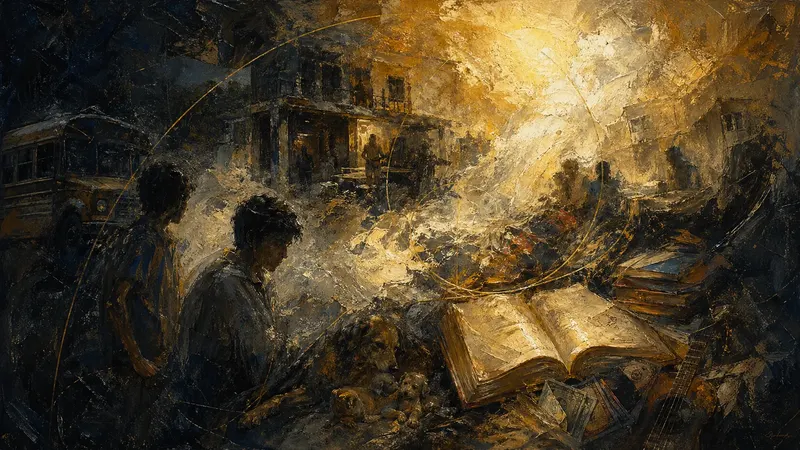
At the time, I was beginning to take Bible study and persistent prayer very seriously. I read the Bible every day, prayed, and sought God with that strange adolescent intensity where naïveté and real hunger become mixed together. The Bible was not a domesticated book to me. It was an ocean of wisdom contained in the old pages of a book I had recovered from my father’s shelves, a book my great-grandmother had once used and that still held some of her notes. I was reading Genesis: the story of Joseph, sold by his brothers, imprisoned, forgotten, interpreting dreams, understanding that beneath a strange image such as thin cows devouring fat ones like lions, there could be a warning, a direction from God. That story had taken hold of me.
I was studying the arts. We traveled in a small bus that picked us up and took us to school. Lisi rode there too, a reserved girl from school and part of the same Christian circle, but not someone whose life I knew. One day she looked troubled, and I asked her what was wrong. I was more outgoing, more intrusive, more guaroso, as we say in Cuba. She told me she had had a dream that left her shaken: a dog and her dead puppies, specifically a dog that gave birth and then lay on top of her pups until she killed them. An ugly, disturbing image like the cows. And the dream would not let her rest.
Imagine the context. I was reading Joseph constantly, thinking about dreams, symbols, interpretation, about God speaking through strange images. I told her that some dreams could have an interpretation and asked her, somehow, whether she thought God might be trying to tell her something. Then I tried to interpret it.
I did not hear a voice. I did not see a light. Nothing cinematic happened. What came to mind was a connection: the dog was the work her family did, the puppies were the fruit of that work, and that was all. From that alone I reasoned that if the image spoke of death, then the family’s work was going to destroy the fruit of its own labor. I told her that. Then I asked a question that came out of my reasoning: Is there anything illegal or irregular going on in your home? She said yes.
This matters, which is why I am emphasizing it. I knew nothing about her life. I knew nothing about her family, the business, the police, or the problem. She had given me no prior information from which I could deduce anything beyond the dream and the impression that God had placed in my mind in relation to its interpretation. The question came from me. And in Cuba that question carried a particular weight because not everything illegal was immoral. Often illegal was the administrative name for survival: trading, reselling, resolver or finding a way, diverting resources, inventing an economy underneath the official economy. The entire country was built on that tension between what was allowed and what was necessary.
Even so, what I told her was specific. I did not say that something bad was going to happen in general, or that she had a strange energy, or offer some spiritual vagueness flexible enough to fit anything. I told her that the family’s work was going to destroy the fruit of its own labor, and I asked whether anything illegal was happening there. That is not a horoscope. That is something else.
The Proverb That Opened in My Hand
Then I did something I am still uncomfortable admitting because it can sound superstitious. I opened the Bible and put my finger on a passage. It was not a practice I wanted to turn into a method. Even then, I understood that this was not something to use as a game. But I did it.
My finger landed on Proverbs 28:22:
The stingy man hastens after riches, and does not know that poverty will come upon him.
I showed it to her. It was not a generic verse about patience, comfort, or hope. It was a proverb about someone who runs after wealth and ends up meeting poverty. And it fit the center of her family’s situation with tremendous force. They were trying to prosper through an irregular path. They expected wealth, and loss came instead.
My mother-in-law had been born into poverty and had built much of her identity around getting ahead, trading, making money, and proving she could succeed. I do not say that as criticism. Poverty marks and humiliates people, and sometimes a person who manages to escape it turns money into a form of dignity. But the proverb landed at the center. I later learned that my mother-in-law had been born on a farm between Codicia and Dolores, literally Greed and Sorrows, the names of the two neighboring places. In retrospect, that detail unsettles the adult skepticism I now bring to some biblical place names that seem to fit their stories a little too perfectly. I did not know it at the time, but everything around this event fit: expected wealth, real loss, poverty walking through the door.
The conversation took place on Friday. Lisi is certain the seizure happened no later than Sunday. That weekend, the police confiscated almost everything her family had accumulated. The family’s work had destroyed the fruit of its own labor.
Why the Answer Was Not to Prevent the Blow
Afterward, Lisi herself connected the events to our conversation. This was not me rearranging the story years later. She made the connection then. And on Monday morning, when we met again on the bus to art school, she asked me a question that remains, for me, one of the most important parts of this whole episode: Why did God tell me that if He did not give me time to do anything?
It is a brutal question. If you understand God in a childish way, a warning should help you avoid the blow. God warns you, you act, everything is saved. But life almost never works that way, and neither does the Bible.
I asked God what the point of it had been. What came to mind was this: so she would know that I will be with her through the process. Not to prevent it. Not to spare her the loss. Not to turn pain into a movie with a comfortable ending. So she would know she was not alone. Yes… the Christian God weaves a net of trust through our lives that protects us from the free fall of unbelief, and He often does it through things in our own lives that would carry no weight on a cosmic scale.
When those words came, I did not know some of the details yet. I did not know that her personal money, hidden inside some books, would not be confiscated. The police went through those books, and when one officer was close to finding the money, another told him to leave that alone and go somewhere else. Nor did I know that the family’s instruments would not be confiscated, or that those instruments held money belonging to her parents that would later help them endure the blow.
The answer was not: God will prevent the seizure. The answer was: God will be with you through the process. And what happened took exactly that form. The loss was not prevented, but provision remained. The blow was not canceled, but not everything was destroyed. There was no spectacle, but there was a hidden reserve.
That is profoundly biblical. It is not a genie in a lamp or a god who turns every problem into comfort. It is the God who warns, accompanies, allows us to pass through, and sometimes leaves bread hidden in the middle of the ruins.
That is why this story does not point me merely toward some generic spirituality. It points me toward Christianity. It happened while I was reading Joseph, within a conversation about dreams and interpretation, it was confirmed when the Bible opened to Proverbs, and it dealt with wealth, poverty, work, fruit, loss, and provision. This is not spirituality of just any brand. It has Christian grammar.
Memory Is Evidence Too
Someone can tell me: That is a lie. Memory deceives you. Maybe even you do not remember the story correctly. And they are right to say it. Human memory is not a camera. Stories become polished, details blend together, and we often remember the meaning more clearly than the exact sequence. I do not want to defend this like a fanatic. A fanatic is of no use to me in defending the truth.
That is why I asked Lisi about it point by point. I can be so absurd that I made her a Google Form with dozens of specific questions. I asked her to answer on her own, without consulting me, without reading my version, without letting my account guide her. Her answers confirmed the core: I knew nothing about her life, she had not told me about the business or the problem, the question came from me, the seizure happened soon afterward, she herself connected the event to the conversation, and some of the money was strangely spared during the seizure. It was no longer my memory alone. My principal witness lives under my own roof, is no stranger, and remembers it all just as I do.
The question, then, is not whether I can prove this to the world the way one proves an experiment. I cannot. No one can return to that bus, look inside my adolescent mind, or recreate that Friday, the Bible, the dream, the question, and the seizure. The real question is what I do with it.
Probability and Context
This is where I like to sit down with the honest atheist, not the militant one, and do the sums out loud. If naturalistic atheism were true, it would have to explain the whole chain as an accumulation of coincidences. By chance I happened to be reading Joseph. By chance I noticed that Lisi looked troubled that day. By chance she had dreamed about loss. By chance I interpreted it in terms of work and illegality in her family and happened to be right. By chance the seizure happened that same weekend. By chance the Bible opened to Proverbs 28:22, the very verse that connected to what had happened. And by chance, hidden provision remained in the middle of the blow.
That can be said, of course. Anything can always be explained if one is willing to pay a high enough explanatory cost. But there comes a point when the naturalistic explanation stops sounding like sobriety and begins to sound like a defense.
I do not have an exact number, but the order of magnitude can be estimated, the way rough probabilities are often explained through familiar examples: winning a lottery, being struck by lightning, guessing a sequence of coin tosses. If you take the entire chain and adjust for memory, dependence between variables, and the Cuban context, the case still lands in the range of billions to one against chance, according to Opus 4.7 and GPT 5.5 Pro running at their maximum reasoning settings. I do not need the number to be perfect. Understanding the size of the problem is enough.
It is like trying to predict the exact sequence of more than thirty consecutive coin tosses before tossing them.
And if this had happened to me in some random context, perhaps it would only push me to believe that there is more than matter and chance. But it did not happen in some random context. It happened within Christianity, with Christian symbols, biblical reading, biblical interpretation, a biblical proverb, and a spiritual answer that fits the biblical understanding of providence.
The Girl Who Did Not Rise from the Dead
I have not always been cautious. I have another story that vaccinated me against the fantasy of thinking I was a prophet, and it seems important to tell it now because without it, the first story can sound like cheap triumphalism.
Some time later, while reading the Gospels, I reached the passage of Talitha cumi: entering the room, Christ takes the dead girl by the hand and tells her to get up. Around that time, I heard at church that a girl had drowned and was somewhere between life and death. I sincerely felt that God wanted me to go and pray for her. I rode there on my bicycle. By the time I arrived, she had died. Her family did not know me, but they allowed me to pray. I prayed out loud. I asked for her to rise. The doctors and nurses laughed. The girl did not rise. I still remember the sickly sweet, unpleasant smell of her little purple, dead body.
It was devastating. That night I ended up lying in a park, looking at the stars, asking myself what to do with it. My conclusion was that I could be wrong.
That second story does not invalidate the first. It calibrates it. It keeps me from turning a real experience into a system, from saying that every inner impression comes from God, from playing at interpreting dreams or promising miracles. It taught me that human discernment is fragile, even when faith is sincere. But it does not erase what happened with Lisi. On the contrary, it gives the story healthy limits.
Real Christianity has room for both things: a providence that appears with a precision impossible to forget, and a mistaken boy who confused zeal, pain, biblical reading, and an inner impulse. The Bible never presents faith as a straight line of absolute clarity. It presents signs and silences, miracles and tombs, true prophets and failures of discernment, Joseph interpreting dreams and Job understanding nothing.
The Christian world is stranger, harsher, and deeper than the caricature many believers and many atheists carry in their heads. The certainty on both sides is sometimes unjustified.
Why I Cannot Be an Atheist
I hope I have offered reasons valid enough to state this conclusion: if I ever grow tired of God, my honest exit would not be atheism. It could not be. It would be Job. It would be Jacob wrestling with the angel. It would be Psalm 88 ending without light. It would be a wounded faith, even an angry faith, even a silent one. But not denial.
As I said at the beginning, this is not the only reason, nor the only valid one. We have philosophy, history, the personal transformation of character, and so on.
But even if I had none of that, denying God, in my case, would not be intellectual neutrality. It would be treating my own biography as though it were not evidence. It would be looking at one of the strangest and most significant episodes of my life and saying: This does not count because it does not fit the system. And I cannot do that. Not honestly.
I cannot be a naturalistic atheist because I would have to do too much violence to what I know I experienced. And truth matters too much for me to betray it.